


Training Files & Workouts
Below are a collection of some workout files constructed in Training Peaks.
Also outlined is the typical process of what you need to do with the file if you are unsure.
The files provided are directly from Training Peaks in either .ZWO for power based or FIT for heart rate based , you can either download and then import these into your own Training Peaks account or if you don't have a Training Peaks account but use Zwift you can save the file on your PC in the required Zwift program folder and it will then be visible under your custom workouts folder in Zwift. Note, Zwift will not recognise FIT / heart rate based workouts.
1. Import into Training Peaks - https://help.trainingpeaks.com/hc/en-us/articles/32432105650573-Import-Planned-Workouts-into-TrainingPeaks
The assumption here is that your Training Peaks account is linked to your Garmin, Zwift, Wahoo accounts, or whatever platform you use to then execute the session.
2. Save file onto your PC in the Zwift folder - https://support.zwift.com/en_us/custom-workouts-ryGOTVEPs#Importing_Custom_Workouts_Today's_Plan_or_TrainingPeaks
If you get stuck or are not sure then just reach out and we will endeavour to assist you.
Enjoy.
Repeated Sprint Intervals

This session ticks pretty much all the boxes and is particularly excellent for those athletes who are time crunched.
I like to schedule these sessions over a 6-8 week block and to build in some progression too. Moving from 10 efforts per
block up to a maximum of 20 depending on the athlete in question.
As stated this can be performed periodically any time of the year, but I actually think this is good to do during the offseason
along side those more standard Z2 endurance rides. This keeps everything primed but doesn't tax any one system too much.
On paper it doesn't look that hard, but if performed correctly those 50s of rest pass quickly. Click the button below for the file.
Short Tempo -> Threshold Spikes

Another session for the time crunched athlete (6-8hrs pw) where we start to introduce some intensity in the form of tempo and sweet-spot.The blocks are fairly short and repeatable at this stage so mentally it's less daunting than longer blocks of the same intensity.
You still accumulate 24mins in Z3 and 12mins in Z4 - just below your anaerobic threshold.
At this stage we are staying below the anaerobic threshold to limit fatigue and make the session quite repeatable.
It will also act as gauge as to where your current threshold sits.
Take a look at your heart rate data afterwards and if you have more time in Z4 than Z3 then you might have your FTP set too high.
Progression wise i'd say do this for 2-3 weeks, maybe extend the intervals by number or duration slightly over that period and then move on to the more classic 10-20 min intervals at a similar intensity. Again keep an eye on that heart rate to power relationship as this can be quite telling as to when it might be time to move on. Click the button to download the file.
Sprint Interval Training 10 x 10s

When it comes to intervals most people usually go straight to Vo2 max and Threshold type interval sessions and with good reason, they are potent and have a big impact on your fitness if programmed and executed correctly. However what you don't often see many people doing are sprint interval sessions of this nature, probably in the misbelief that they are the preserve of sprinters and that there is little point in doing them unless you are looking to race.
As with RST (repeated sprint training) you get a lot of other downstream benefits beyond the neuromuscular recruitment of type II muscle fibers. Unlike RST where you will gradually find that you won't be able to hit max power due to the repeated efforts and short rest. This session allows for full recovery of your phosphocreatine (PCr) stores so that you can hit close to if not your max power each time. And with that you are getting a much higher motor unit recruitment. But as i said there are also downstream benefits which can help enhance mitochondrial biogenesis and cardiovascular & Oxygen transport adaptations. There is also a big anabolic hormone response which can help create an acute spike in testosterone, growth hormone and IGF-1.
The other reason i like these as opposed to only doing longer Vo2 and Threshold stuff is that the execution is often easier as there is no need to pace these efforts, you just go full gas for the 10s.
Progression should take the form of gradually stretching the duration out whilst reducing the number of efforts. 5-6 x 20s being plenty.
LT1 Modulation
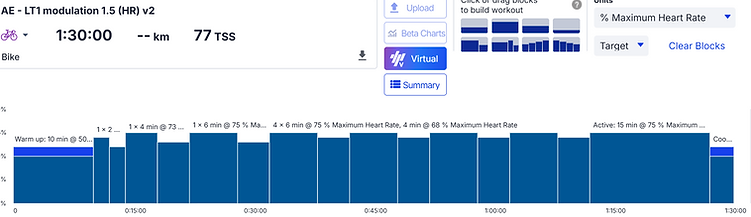
When it comes to laying aerobic endurance foundations the key is to go just hard enough that you create some sort of metabolic disturbance but not so much that you struggle to recover from it, in the way you would if you did similar blocks at your LT2 or maximal lactate steady state (FTP). The key here is repeatability and the ability to recover quite quickly so you can stack multiple days back to back. This is classic Z2 training but with a twist and sharper focus, pushing you ever so slightly harder to help drive those all important adaptations 👇
-
Upregulates mitochondrial density and efficiency - in slow twich (type 1) muscle fibers.
-
Enhances the muscles ability to utilise fat, sparing precious mucsle glycogen.
-
Increased cardiac output, crucially promotes capillary density growth around the muscle fibers - i.e. more and better oxygen delivery.
-
Improves lactate clearance not just production. By working slightly above LT1 (those higher blocks) you create manageable, low-level lactate disturbance. This improves the ability to shuttle and reuse lactate as a fuel source.
-
Reinforces neuromuscular efficiency at sustainable power, improving communication between your nervous system and muscle fibers. As i always tell my athletes, all training is brain training too.
Vo2 Max Descending Intervals

The Science of "Descending Duration" VO2 Max Intervals
The classic approach is repeating the same interval (e.g., 5x5 mins). The "descending duration" method (starting long, finishing short) is a more sophisticated strategy that leverages fatigue management to achieve a greater cumulative time near your maximum oxygen uptake (VO2 max).
-
Front-Loads Neural & Muscular Stress: The longer intervals (3 min, 2 min) at the beginning require significant muscular coordination and mental focus when you're fresh. This effectively "primes" the cardiovascular system and recruits high-threshold muscle fibers.
-
Enables Higher Quality & Power Maintenance: As fatigue accumulates from the initial longer efforts, the work intervals become shorter. This allows you to repeatably hit and even exceed your target power (115-120% FTP) in the later 40-second intervals. If you reversed the order, fatigue would prevent you from completing the longer intervals at the required intensity.
-
Maximizes Time in the Zone: The primary goal of VO2 max training is to spend 15-20+ minutes cumulatively at an intensity that stresses your body's maximal oxygen transport and utilization system. This structure tricks your body into achieving that total by making the later, shorter intervals sustainable despite high overall fatigue. You accumulate more time >115% FTP than you could with standard sets.
-
Psychological Advantage: Mentally, finishing a hard session with shorter, "bite-sized" efforts feels more manageable than grinding out another long interval. This improves adherence and effort quality.
Essex Resevoir Race Sim

I got hold of eight power files from the same 2/3/4 road race at Essex
Reservoir. Same 82.5 km, same six laps, same flatish circuit, same wind.
The rider who finished 8th had the best peak power at every single duration —
5 seconds, 30 seconds, 1 minute, 5 minutes, 20 minutes. Best in the field.
He averaged 332 W and burned 2376 kJ.
The rider who finished 2nd averaged 243 W and burned 1732 kJ.
At the same speed, on the same road, in the same bunch: 217 W versus 303 W.
That 86 W isn't fitness. It's position.
And the moment it was decided wasn't the attack. From 32 to 57 km the race did
almost nothing — and that's where the eventual 2nd place rider sat at 74% of
FTP while 8th sat above 100%. When the winning move went at 58 km, 8th place
actually produced MORE power than the front group over the next 6 km. He still
lost 40 seconds. The engine was there. The fuel wasn't.
So I've built the whole thing as a 2-hour session you can ride.
Not an interval set — the actual race, in order. The neutralised roll-out. The
first lap at 45.2 km/h that ejected two of the riders inside 6 km. The break at 22
minutes. The lull. The move at 92 minutes that needs 12 minutes at threshold
after an hour and a half of racing. Then the sprint.
IF 0.93. TSS 169. Exactly what the race was.
NM - Standing Starts

A 2026 RCT (de Pablos et al., Universidad Europea de Madrid, published in Scandinavian Journal of Medicine & Science in Sports) put well-trained cyclists into three groups over 10 weeks — one doing standing-start-type efforts (5×7 stationary maximal pedal cycles, seated actually, uphill, ~40rpm/~10s, hitting roughly 70% of max dynamic force), one doing longer moderate torque work (5×4min at 50rpm, 85-90% FTP, only ~35% of max dynamic force), and a control group. The framing of "high-intensity torque" vs "medium-intensity torque" as separate categories is itself telling: the thing that seems to matter isn't cadence, it's relative force. You need to get close to maximal voluntary force to trigger a hypertrophy/strength response — that's just standard resistance-training physiology (mechanical tension near true max is the primary hypertrophy driver, and sustained moderate-force work doesn't reliably deliver that even though it feels hard). So a 7-10s standing start at near-max effort is functionally closer to a heavy squat than to a tempo interval, just expressed through the pedaling pattern specifically — which is also why it transfers better to bike-specific strength than gym lifting sometimes does.