


“Why Your Feelings Matter – Tuning Your Brain with RPE”

In this digest, we're connecting the dots between RPE, energy management, and the most important organ for performance: your brain. Understanding and trusting your Rate of Perceived Exertion (RPE) is a skill that separates good athletes from great ones, and it's crucial for your long-term development.
Believe it or not, your own rate of perceived exertion is actually a very reliable indicator when it comes to executing your training and racing. The more you can develop your own software (neurology) around this, the better rider you will become. It's widely known that the best athletes don't just have superior plumbing (heart/lungs etc.), but they also have very good awareness of their sensations with highly developed neural pathways. This is why just because you might not be a sprinter doesn't mean you should never sprint. You need to work across the full spectrum.
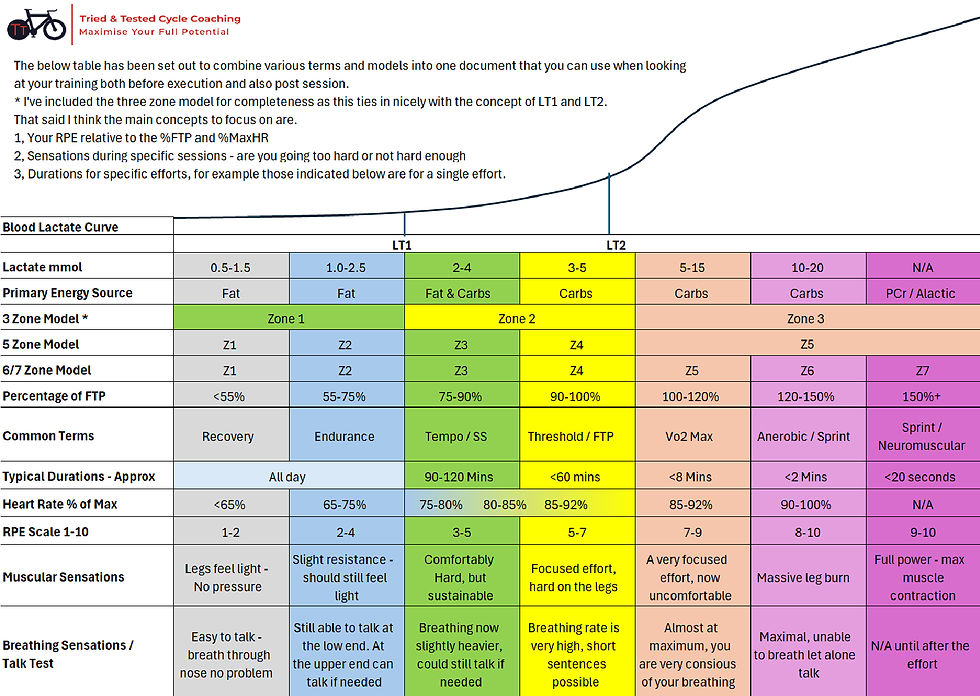
To help you correlate sensation with data, I’ve put together a matrix that aligns RPE with heart rate, power, and traditional training zones. The real power isn't in the matrix itself but using it to calibrate your internal sense of effort. For context, we use the Training Peaks 1-10 scale, where 1 is very easy (walking) and 10 is a maximal sprint.
RPE, like heart rate and power can often drift throughout a session - note how your sensations are at the start, middle and end of your rides to get a better sense of how you executed and performed in your sessions. This can be quite telling on longer rides if you have ridden too hard or not hard enough, or you have misjudged your energy requirements. It's also helpful as it can often indicate areas of weakness such as poor fatigue resistance, or just poor fueling and hydration.
As an example, I set out below how on a longer (over 3 hours) Z2 endurance ride; the following might describe how your RPE could fluctuate, or drift.
Working on the assumption that you are fresh and assuming the temperature is not too hot or cold, i'd say RPE should range from 2-4.
Phase 1: The Warm-Up (0-45 mins)
First 35-45 mins shouldn't feel too hard, however it might if you're carrying some fatigue or you are -> 40yrs (yes older athletes often take longer to warm up) and this can make a ride feel harder early on. Legs feel heavy or stiff, and breathing might feel a little labored. (it's worth noting at this point if you continue with these sensations, you may be seeing the early signs of over training. Could be time for some rest)
Key Takeaway: If your RPE is higher than expected in the first hour despite easy power, it's a prime signal from your body, likely indicating residual fatigue, insufficient warm-up, or stress. Note it; don't ignore it.
Phase 2: The Sweet Spot (45-90 mins)
This is your calibration phase—where RPE, HR, and Power should be in stable alignment if fueling and fatigue are managed
So, the next 45 mins feels more comfortable, breathing is very rhythmic, and you can talk if necessary. You should also be able to eat and drink comfortably.
Phase 3: The Fork in the Road
Your brain acts as a 'Central Governor' to protect the body. Sensing falling glycogen, it starts to increase perceived effort (RPE drifts from 3 to 5/6) and may drive heart rate up (cardiovascular drift) to preserve itself, even if your power holds steady. This is a direct signal you're moving from 'fueled' to 'fuel-critical.'
Therefore after 90 mins if you've just drank water and you didn't have much or anything for breakfast you may start to feel the early signs of fatigue. This won't necessarily be muscle fatigue in the same way you have to stop when you perform a very hard effort but rather, your energy levels (glycogen) in those muscles are starting to run low. Your brain (central governor) effectively starts to limit you as it detects lower energy. The brain will
protect vital organs including itself over you being able to complete your training session; it basically doesn't care.
Most people give or take have about 1800-2000 kcal of stored carbohydrate energy available, or about 2 hours of working at a moderately high intensity, high Z2 low Z3.
Hydration is another one. If you've not been drinking enough and haven't replaced the lost fluids, what started off feeling quite comfortable will soon become quite hard. The effects of dehydration have been well studied and published, i used to be pretty bad at this one and can recall on many a long ride grinding to halt as i'd failed to drink enough, often coming back with mostly full bottles.
Phase 4: The Endurance Arena (2-3+ hours)
Beyond two hours, sensations change. Muscles feel heavier. This is where the true brain training manifests. The experienced athlete isn't just physiologically more efficient at fat burning; their brain has learned, through repeated exposure, that this state is not an emergency. It has been 'taught' to maintain output and manage discomfort without hitting the panic button (the Central Governor). This is why consistent long workouts are non-negotiable for long duration events; you're teaching your brain resilience.
To put this into practice.
Note your Starting RPE: Before you look at power or HR, rate your feel at the start of every ride. Ask: "Does this feel appropriately easy/hard for today's plan?"
Watch the Drift: On a steady endurance ride, note RPE at 60, 90, and 120 minutes. Is it stable? If it's creeping up, ask: Is it fueling? Hydration? Fatigue? Heat?
Trust the Signal: If your RPE is high for a given power output, investigate the why before pushing through. Your brain is often the first to know.
Remember: Training isn't just about building a bigger engine. It's about becoming a more skilled driver, listening to the dashboard (your sensations), and teaching your onboard computer (your brain) to manage the entire system efficiently."
RPE Matrix
Hopefully you find this helpful and if you have any questions, just let me know.


Comments